Sunday, 23 September 2007

I can't speak with all these words in my mouth

“The next real literary ‘rebels’ in this country might well emerge as some weird bunch of anti-rebels, born oglers who dare somehow to back away from ironic watching, who have the childish gall actually to endorse and instantiate single-entendre principles. Who treat of plain old untrendy human troubles and emotions in U.S. life with reverence and conviction. Who eschew self-consciousness and hip fatigue. These anti-rebels would be outdated, of course, before they even started. Dead on the page. Too sincere. Clearly repressed. Backward, quaint, naive, anachronistic. Maybe that’ll be the point. Maybe that’s why they’ll be the next real rebels. Real rebels, as far as I can see, risk disapproval. The old postmodern insurgents risked the gasp and squeal:shock disgust, outrage, censorship, accusations of socialism, anarchism, nihilism. Today’s risks are different. The new rebels might be artists willing to risk the yawn, rolled eyes, the cool smile, the nudged ribs, the parody of gifted ironists, the ‘Oh how banal.’ To risk accusations of sentimentality, melodrama. Of overcredulity. Of softness. Of willingness to be suckered by a world of lurkers and starers who fear gaze and ridicule above imprisonment without law.”

– David Foster Wallace, “E Unibus Pluram” (1993)


I like this quote. I like Cold War Kids for reproducing it in a full-page ad in NME. And yet I'm hesitant to champion its sentiments for a number of reasons.

At first Wallace's essay comes across as completely, almost mind-blowingly, refreshing. Don't you cringe at ironic t-shirts? Isn't sarcasm the dullest form of humour? (I'm reminded of the time that, about an hour after the gig, it finally sunk in for my friend that I really did think Kate Nash's performance at the Dot to Dot Festival was brilliant. A bit like the episode of The Simpsons, 'Homerpalooza': "Oh, here comes that cannonball guy. He's cool." "Are you being sarcastic, dude?" "I don't even know any more.") Aren't you a little worried that you tend to work out life events through examples from TV shows?

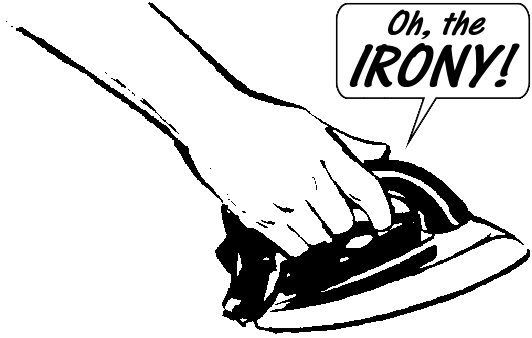
Actually these aren't new questions at all, are they? What Wallace taps into is something that a lot of people have been feeling for a long time, probably since transtextual postmodern irony became the native tongue of a new so-called 'Generation X' society some time in the 1980s. And I say transtextual, because Wallace's use of the phrase 'double-entendre' merely implies one extra meaning, when a lot of the time many layers of textual reference are at work. This picture would merely be a Wallacean (Wallacist? whatever) double-entendre if it weren't for the fact that it was also parodying the Roy Liechtenstein cartoons employed in Douglas Coupland's Generation X, which in turn parodied pop art, which in turn parodied comic strips...

Is your head spinning? It should be. But even if what I've written above sounds like garbled nonsense, that is the process you go through every day, reading irony. You recognise and applaud when TV shows are ripping on other TV shows, or even their own show. It's automatic. When we speak, our generation speaks in a thousand voices.

And yet, isn't that pretty much the way it's always been? Is a 'single-entendre' really a purer, less adulterated way of communicating? I don't think so. I'm not as sure anymore, as I once was, that people hide behind irony and postmodern discourse, or that pop culture references are used as a substitute for humour. Not always. Sometimes we yearn, like Wallace (and Cold War Kids), for clarity of expression. But here's the clincher: Cold War Kids quoted Wallace to get their point across. Sometimes the language we speak is garbled crap - I apologise if mine is in my clumsy attempt to get a point across - but sometimes it's just richer.

Otherwise there'd be no poetry.

Sunday, 2 September 2007

Daniel Kitson

"We must reclaim the night from the cunts and the slags because the night is when the adventures happen. Moonlight, starlight, candle light and torch light: those are the four adventure lighting options."

Friday, 31 August 2007

'The liberals can be just as bad...'

Another quote plucked from the (electronic) lips of Ms. E.A. Black, and just something that's struck me as true lately. Or, in some cases, it might be more apt to say that the conservatives can be just as bad. It all depends upon what quadrant of the political compass the status quo lies really.

First case in point.

Wheen makes a lot of good points about political beaurocracy, purposefully opaque intellectual posturing and pseudo-scientific mysticism. Unfortunately chapter after chapter is crammed with abominable non-sequiturs, offering his Mail-reading fanbase a chance to dismiss anything that is difficult to understand by tarring it with the same bullshit brush waved at much easier targets, such as astrology.

Let's just say there is a lot of intellectual foul-play on Wheen's (and his peers') part at hand. One of the most dishonest critical, intellectual, even scientific practices is to take the exception and hold it up as the rule - or to take the extreme and present it as the commonplace. So critical theory takes a bashing by way of some daft excesses in the field of feminist theory (Luce Irigaray's notorious criticism of E=mc2 as a 'sexed equation' because it values the speed of light over other equally necessary forces is just one example of her barminess) and linguistics (the otherwise groundbreaking Saussure, who equates the 'erectile organ' to the square root of minus one). Writers such as Wheen and Dawkins, and no doubt many more, have followed this with some kind of withering reference to 'trendy French philosophers', usually namechecking Foucault or Deleuze/Guattari. And just like that, in a breath, the whole French tradition has been swept under the rug. Barthes' accessible, emotionally frank and at times moving works, gone. Foucault's extensive histories of sexuality, dismissed.

Second case in point. (Be sure to read the liner notes at the bottom of the page.)

Critical and cultural theory is a much maligned field of academic study, and the embarassing truth is that a lot of it is dismissed simply because it is goddamned hard. Derrida is infamously capricious in his thinking, and certainly not one I would put forward as an ambassador for the the utility of cultural studies, but even this trickster offers a wonderful glimpse into the way we order the world, if persevered with.

A lot of it is also dismissed, however, as part of a trend (sometimes) mistakenly labelled as 'postmodernism', misconstrued as a kind of 'anything goes' philosophy where everything is relative and there is no truth. There are thinkers like this, but again, they are not representative. This is what I meant in the opening paragraph. The liberals can be terrible for all sorts of reasons - I'm applying it to something of specific interest to me here - but mainly because they can be too easily lost in theory. The conservatives are too wary of theory, often describing what is essentially their own worldview, with its peaks and troughs of knowledge about that world, as 'common sense' or 'the real world' (the latter will grate particularly on graduate students!).

Why does cultural theory come in for such a hard time? So much political writing is dross, and yet we count it as an essential part of human intellectual endeavour. English Literature is an outdated institution (especially the way it is currently taught) and yet we cling to it and defend it, even if a degree in English Literature is as relevant - or, I would suggest, less relevant - than a degree in Cultural Studies. There is one reason I would dare to suggest, and it is this: Cultural Studies is new, which means that (a) it is treated with hostility and derision, because it does not carry the historical distinction of better aquainted academic studies, (b) it is simply less understood. There is a lot of crap written under the banner of Cultural Studies, like there is for any of the Humanities. And yet, as I have only very briefly pointed towards, it already carries a rich history of its own, in danger of being ignorantly washed away under the tidal wave of 'anti-postmodernist' rhetoric.

Never has the baby been thrown out for the sake of so little bathwater.

Wednesday, 1 August 2007

Sound & Vision

Mark Ronson plays Phil Spector for the day. No wait! It's good. There's no trumpets or anything... I think. Candie Payne has a wonderful voice, it's a shame she wasn't in the Pipettes, and that the Pipettes didn't have more good songs.


This is a song that was included on that actually-quite-good NME cover CD, Canadian Blast. Reminds me of Radiohead's 'How To Disappear Completely' a little bit, especially the bassline that sort of starts to meander its way into it, as if it were drifting itself do you see.


This band are amazing and I'm just gutted it took me so long to find them.


Ditto. This even has guitars in it. Distorted ones. Rar.


This is quite similar to the Weakerthans, but equally brilliant. Ellen probably now regrets texting me about three months ago saying, 'I've found this band I think you'll like,' because every time I went round to her place I put this song on. For a good long while. N.B. Los Campesinos! supported them in Newport too, back in May I think. Probably the most fun gig I've ever been to. I think me and Ellen possibly barn-danced during this.

Sunday, 22 July 2007

Part III.


'I thought it classic...'